
Our Technology Readiness Level (T.R.L.) Definition
Patented Innovations → Ready for integration
Technology Readiness Level (TRL)
The Technology Readiness Level (TRL) describes the current maturity of a technology on a scale from 1 to 9
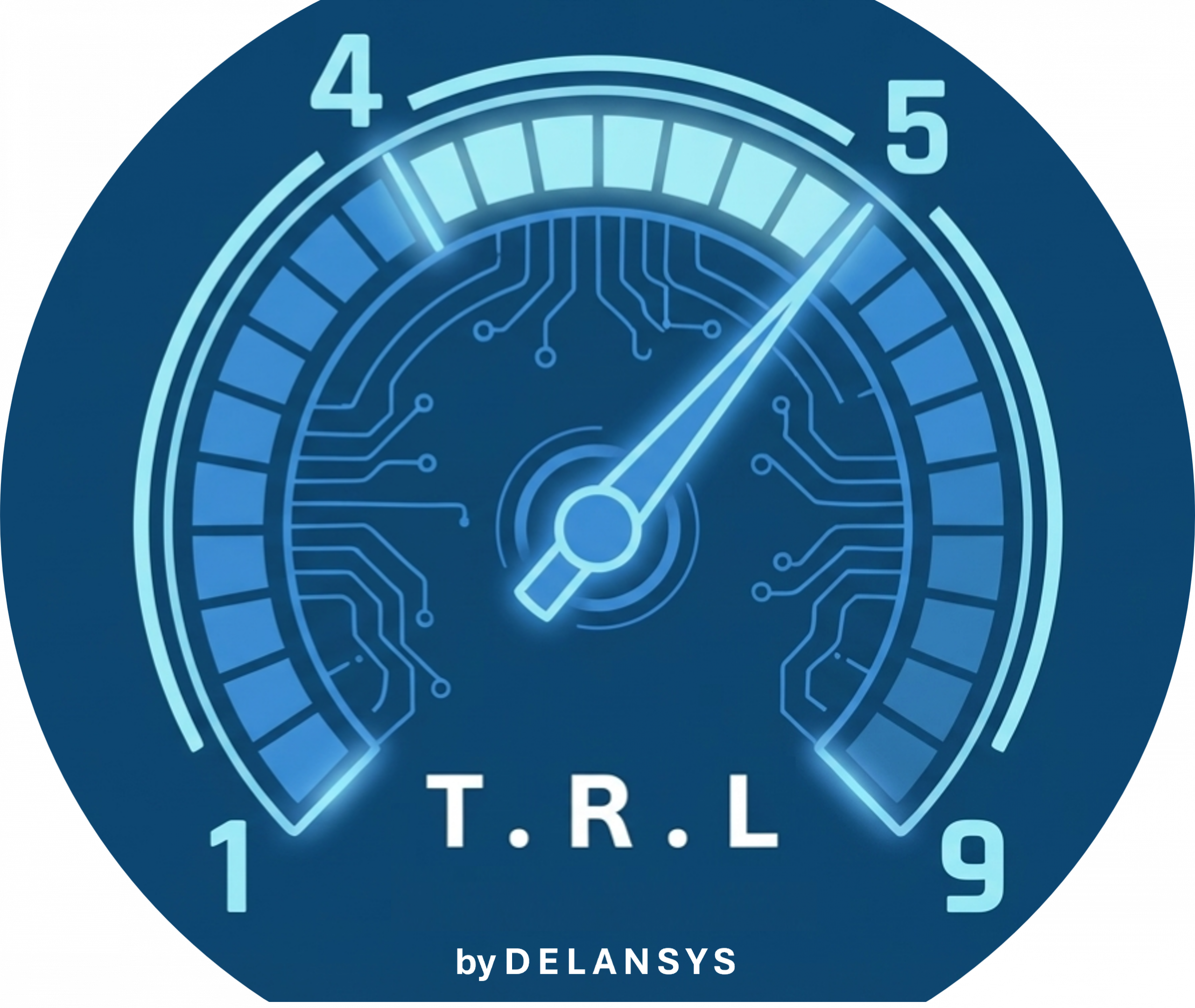

The TRL definition that best fits our Business is the one used by NASA , which we use as the basis for our own classification.
Remark: The German government have a similar definition:
German Government TRL Definition
| TRL | ||
|---|---|---|
| 1 | Basic principles are investigated | Scientific basic research was implemented and applied to prove the basic functionality. Question to be answered: Is it even possible? |
| 2 | Technology concept is formulated | The basic principles have been worked out. Feasibility studies were created and tested. Question to be answered: Can the basic functionality be proven in the laboratory? |
| 3 | Analytical investigations and proof of concept completed | Analytical investigations combined with laboratory tests have confirmed the concept. The characteristics and limits of the concept are highlighted more explicitly. |
| 4 | Concrete devices / components are tested in the laboratory | Concrete devices or components were designed, constructed, and tested in the laboratory to demonstrate functionality in a product or system. |
| 5 | Concrete devices / components are tested in simulated environments | Concrete devices or components were tested in simulated environments to prove suitability regarding shock, vibration, heat, etc. This is typically the level of technological maturity at the end of a new technology development. |
| 6 | Beta-Tests completed | The devices/components were tested by a leading user in the real environment where the product will ultimately be used. This typically happens within a new launch or a customer introduction. The device/component would be part of a unit tested by a leading user in a beta test. In some cases, the beta test can also be carried out as part of a new technology development. |
| 7 | Design and tests of the deliverable product completed | Based on the prototype tests, the technology was developed into a deliverable product or system and tested in the laboratory. |
| 8 | Field tests and qualification of the deliverable product completed | First production units were tested by leading users in practical use to validate the design in real end-user environments. Manufacturing has worked out the necessary processes and suppliers. Field tests have confirmed the design. |
| 9 | The final design is released for full production. | Based on the field tests, the design was adapted to the customer's requirements, and it was proven that it can be produced reliably. This would be the final state for the introduction of new products and the introduction of new customer products. It is the end point of "Time to Market". |
Scientific basic research was implemented and applied to prove the basic functionality. Question to be answered: Is it even possible?
The basic principles have been worked out. Feasibility studies were created and tested. Question to be answered: Can the basic functionality be proven in the laboratory?
Analytical investigations combined with laboratory tests have confirmed the concept. The characteristics and limits of the concept are highlighted more explicitly.
Concrete devices or components were designed, constructed, and tested in the laboratory to demonstrate functionality in a product or system.
Concrete devices or components were tested in simulated environments to prove suitability regarding shock, vibration, heat, etc. This is typically the level of technological maturity at the end of a new technology development.
The devices/components were tested by a leading user in the real environment where the product will ultimately be used. This typically happens within a new launch or a customer introduction. The device/component would be part of a unit tested by a leading user in a beta test. In some cases, the beta test can also be carried out as part of a new technology development.
Based on the prototype tests, the technology was developed into a deliverable product or system and tested in the laboratory.
First production units were tested by leading users in practical use to validate the design in real end-user environments. Manufacturing has worked out the necessary processes and suppliers. Field tests have confirmed the design.
Based on the field tests, the design was adapted to the customer's requirements, and it was proven that it can be produced reliably. This would be the final state for the introduction of new products and the introduction of new customer products. It is the end point of "Time to Market".
Our Innovations and Their Technology Readiness Level (TRL)
Our patented innovations have been demonstrated and proven in real development projects, significantly increasing their Technology Readiness Level.
Clear objective:
To provide our customers with technologies that have already passed the critical early development stages; and reached a TRL that minimizes innovation risk.
Validated Innovations Typically TRL 4 or TRL 5
Before we offer an innovation to our customers, it has already reached at least TRL 4.
This means:
- The technology has been functionally validated
- The core principles have been proven in a relevant environment
- It is close to being ready for integration into your product development process
In many cases, our innovations reach TRL 5, providing even higher confidence and reducing integration effort
Support Beyond TRL 5 (When Needed)
In selected cases, and in close cooperation with our customers, we also support the beta-testing phase (TRL 6) as part of the knowledge-transfer process during technology integration.
This ensures a seamless transition from validated innovation to real-world application.
Our main goal:
Once the first integration project is completed, our customers should have gained all the know-how needed to continue development independently; even when applying the technology to entirely new products.


Getting in Touch - The First Contact
Tell us what you need. Together with our strong partner network, we accelerate your innovation journey.
Trustful · Efficient · Fast-Track · Real Innovation
